Rules
Part of A sustainable material brand checklist: twenty things to verify first
Top sustainable material brands, rated on evidence rather than hype
Sustainable material brands get rated on evidence rather than hype, showing which certifications and documents renovators can verify before they buy.
What to take away
- Nine sustainable material brands publish third-party documents a renovator can pull and read before ordering. They include Interface, Shaw, Tarkett, Milliken and Columbia Forest Products. Mohawk, Armstrong Flooring, Cosentino, EcoTimber and Daltile complete the list.
- The document matters more than the logo: an EPD, a HPD or a CARB Phase 2 label names the certifier and the scope.
- A product on a shelf is not proof of current compliance, because stock predates rule changes.
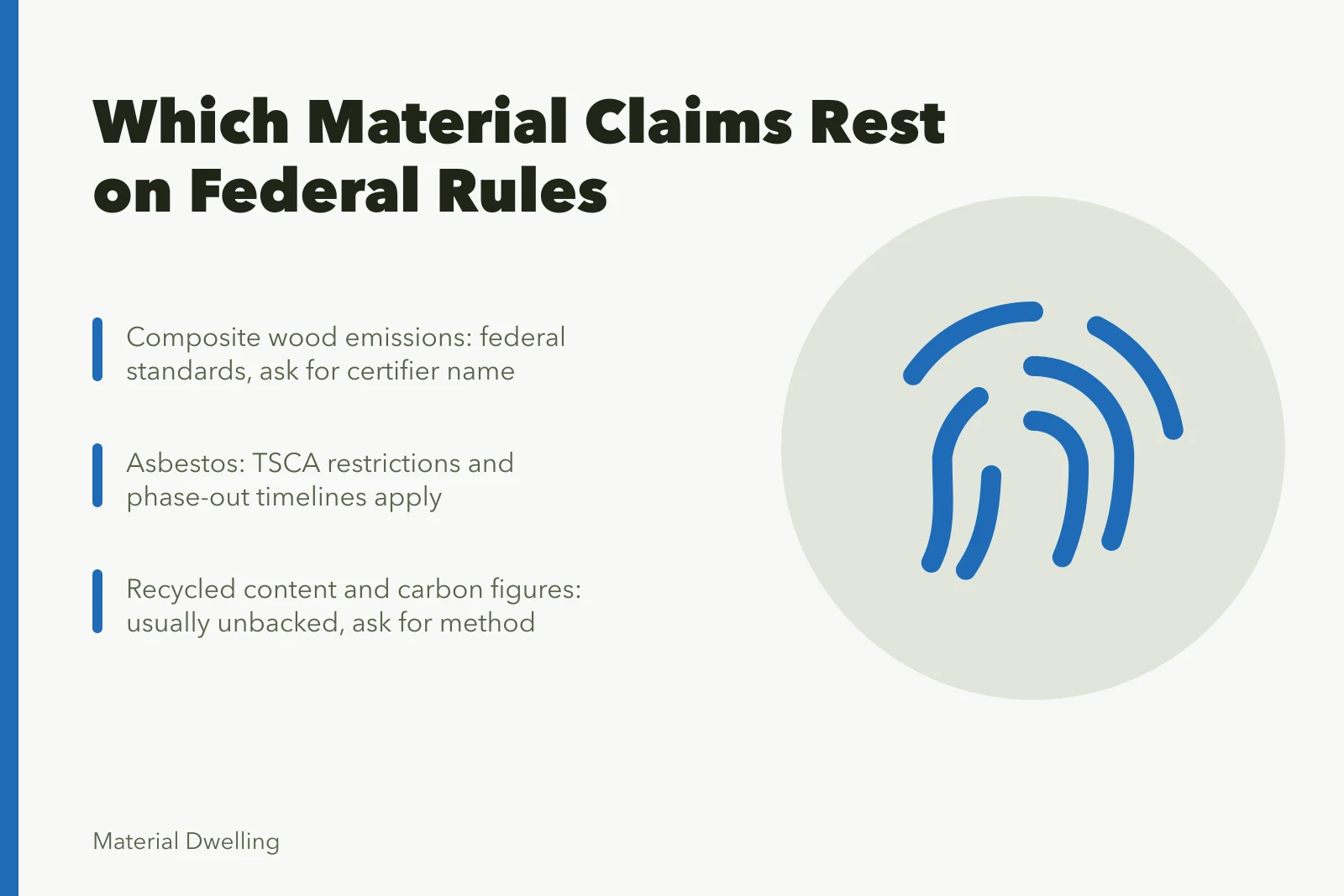
- Asbestos restrictions under TSCA are the clearest case of a rule that changed what is legally sold.
- Where no rule backs a claim, ask for the calculation method and decide how much weight it carries.
The brands, rated by the documents they publish
Rating rule: A means the brand publishes a product-level EPD and a second third-party document for the same range. B means one of those documents is missing, covers select lines only, or is a category document rather than a product one.
The bands come from what each brand lists publicly today. Request the current file before you order, because coverage changes by line and by year.
| Brand | Material focus | Document to request | Rating | Suits |
|---|---|---|---|---|
| Interface | Carpet tile, modular flooring | EPD per product line, HPD | A | Commercial and multifamily floors |
| Shaw Industries | Carpet, resilient, hardwood | EPD, Cradle to Cradle certification | A | Residential and light commercial |
| Tarkett | Vinyl, linoleum, carpet | EPD, Cradle to Cradle certification, ReStart take-back | A | Schools, clinics, rental units |
| Milliken | Carpet tile, LVT | EPD, Declare label, HPD | A | Offices, higher education |
| Columbia Forest Products | Hardwood plywood, panels | EPD, FSC chain-of-custody, PureBond soy-based bond | A | Cabinets, built-ins, millwork |
| Armstrong Flooring | Vinyl, laminate, linoleum | EPD, FloorScore listing | A | Kitchens, baths, rental units |
| Cosentino | Quartz and mineral surfaces | EPD, Declare label | A | Counters, vanities |
| Mohawk Industries | Carpet, laminate, resilient | EPD, Declare label on select lines | B | Volume residential work |
| EcoTimber | FSC-certified hardwood | FSC chain-of-custody, CARB Phase 2 label | B | Solid and engineered wood floors |
| Daltile | Ceramic and porcelain tile | Category EPD from the tile industry, product file on request | B | Floors, walls, wet areas |
A rating tells you what to ask for, not what the product is worth. Ask for the named document and read the cover page. It names the certifier, the standard, the product line and the period covered.
Each of these publishes an Environmental Product Declaration or a Health Product Declaration for at least part of its range. An EPD states the embodied impact of a declared unit, so compare two EPDs only when the declared unit and boundary match.
Documentation does not usually add much to the price. In most US markets, carpet tile with a published EPD typically runs $2 to $5 per square foot installed, and sheet vinyl $1.50 to $4 per square foot, close to the band for undocumented stock at a similar wear layer.
Reading the document without being misled
An EPD reports an industry average for some product categories, not the specific batch you receive. Check the declared unit, the boundary and the reference year before you treat two numbers as comparable.
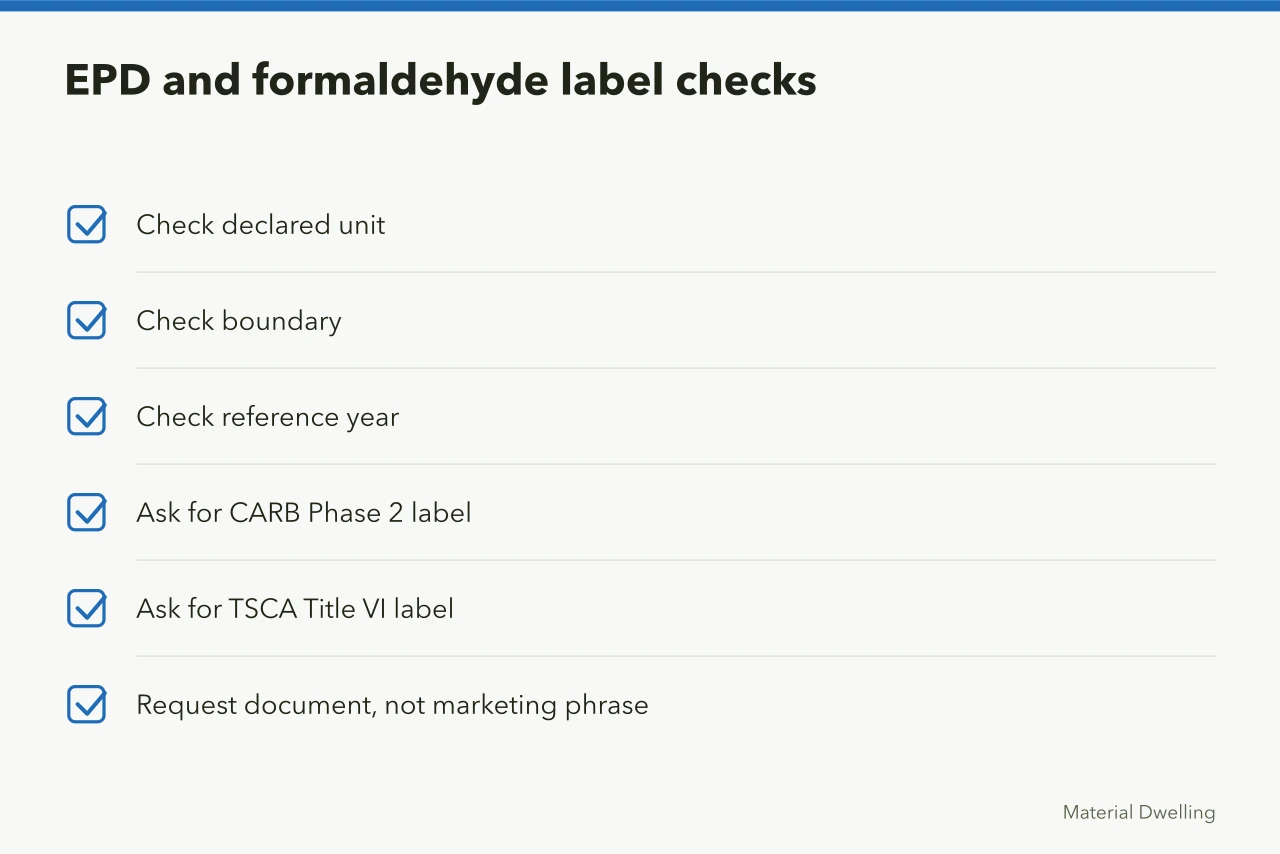
Composite wood carries a federal floor. CARB Phase 2 and TSCA Title VI set formaldehyde emission limits for panels, and the label names the certifier. Ask for that label rather than a marketing phrase.
If a brand cannot produce the document, that is your answer. The first steps for vetting a sustainable material brand walk through the request itself.
Why waste language appears across every category
EPA set out the framework in its summary of pollution prevention law and policies, which establishes source reduction as national policy: preventing pollution at the source is preferred to treating or disposing of it afterward.
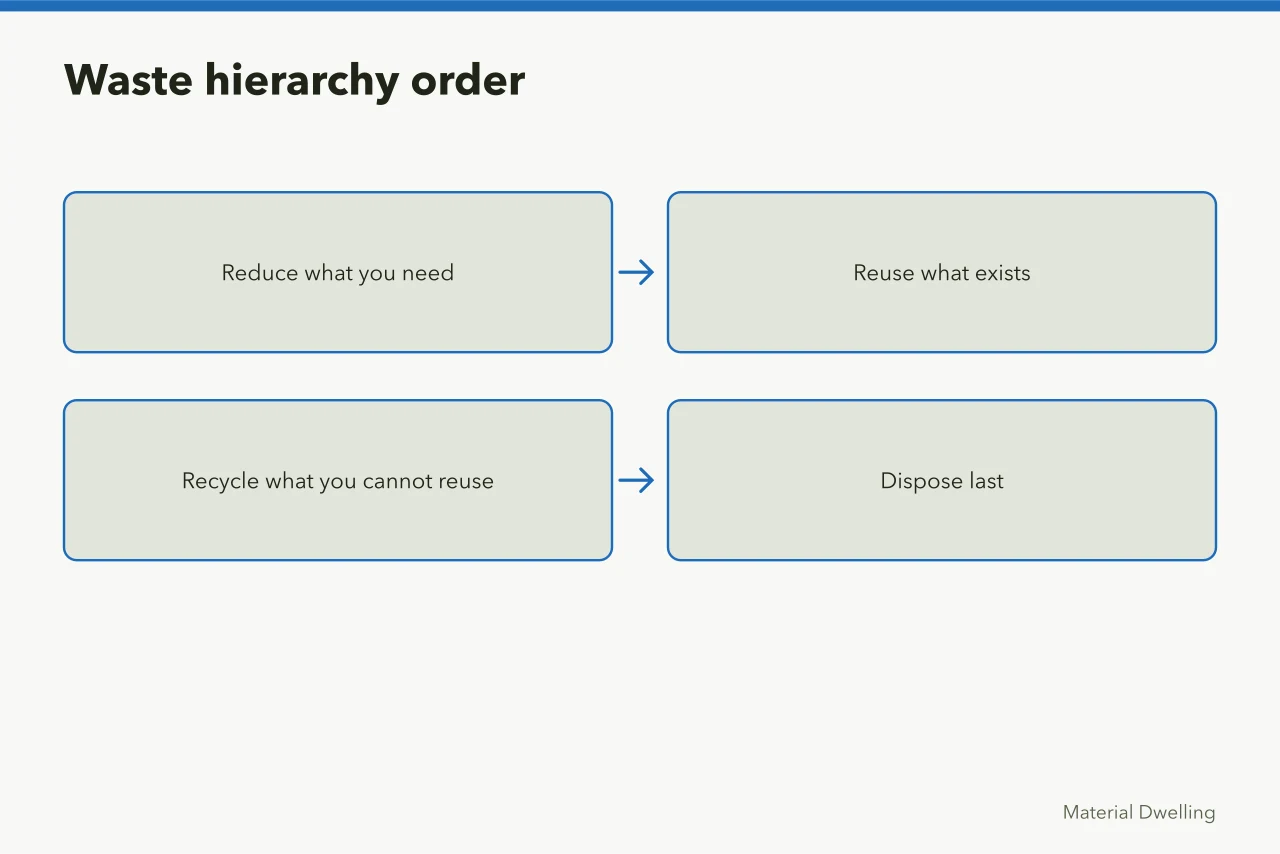
The useful translation is the hierarchy. Reduce what you need, reuse what exists, recycle what you cannot reuse, dispose last. A brand whose story starts and ends at recycling describes the third step as though it were the first.
Restrictions that change what you can buy
Chemical rules move, and availability moves with them. EPA's page on risk management for chrysotile asbestos describes its action under the Toxic Substances Control Act, covering ongoing chrysotile uses and phase-out timelines for the conditions of use it addresses.
Two consequences follow. Stock on a shelf predates the rule change, so its presence is not evidence of current compliance. For imported or specialist items, ask the supplier to confirm regulatory status in writing.
Older buildings run the same logic in reverse. Materials installed decades ago were legal when installed, which is why testing before disturbance beats assuming what was allowed.
What a homeowner can actually verify
You can check a certifier's name against a public list. You can confirm that a document exists and is current. You can see whether a supplier answers a specific question specifically.
You cannot verify a carbon figure, a factory's practices or a durability claim without testing. Narrow those claims and decide how much weight each carries in your decision.
That is the discipline behind our twenty checks for a material brand. It pairs with the permitting and disclosure duties in how permits and codes affect interior materials.
Common questions
Does a rule guarantee a product is safe for my house?
It sets a floor. Installation, ventilation and the products around it still determine what happens in your rooms. For exposure questions, ask a physician or an industrial hygienist.
How do I check current restrictions?
Ask the supplier to confirm status in writing, and read the relevant agency page for the chemical in question. For asbestos, start with the EPA page linked above.
Are imported products held to the same standards?
Products sold in the United States are subject to United States rules. Enforcement varies, which is why documentation matters more than origin.
What if a claim has no rule behind it?
Ask how it was calculated. A supplier who can describe the method is more credible than one who cannot, and you can then decide what the number is worth to you.