Guides
Sustainable flooring, insulation and finishes: how to read a spec
Sustainable flooring, insulation and finishes only become enforceable in the specification: named standards, tolerances, EPDs and the prices that follow.
What to take away
- A drawing says where a material goes. The specification says which product and to what standard.
- Health and carbon claims bind only in a product clause with a named standard and a test method.
- Execution clauses decide durability, and they get cut first.
- Interior painting runs $2 to $6 per square foot; a 120 square foot bathroom typically lands between $8,000 and $25,000.
- Read the general provisions first.
Specifications are where green claims become buildable
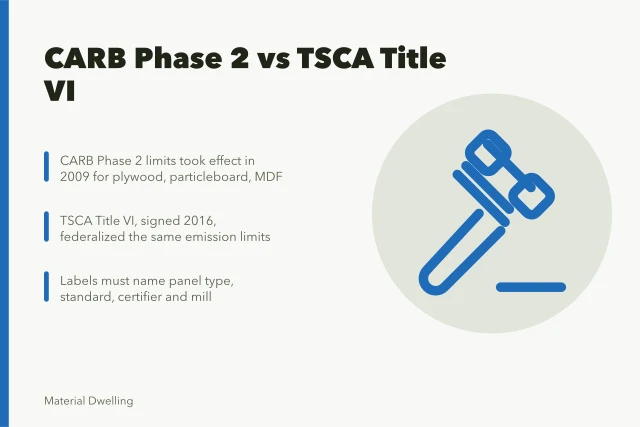
Formaldehyde limits for composite wood sit in two US rules that do not cover the same products. US formaldehyde rules for interior finishes compare CARB Phase 2 with TSCA Title VI and say which applies to cabinets and flooring.
Manufacturers publish plenty about recycled content, emissions and carbon. None of it binds anyone until it appears in the specification. That document states what a material is, how it is fixed, and what standard it meets.
Drawings show where. Specifications show what. A floor that failed, or a finish that smelled in a new house, is usually a specification problem rather than an installation accident.
The three layers, and which one decides indoor air
A working specification has three layers, and only one of them is usually read closely.
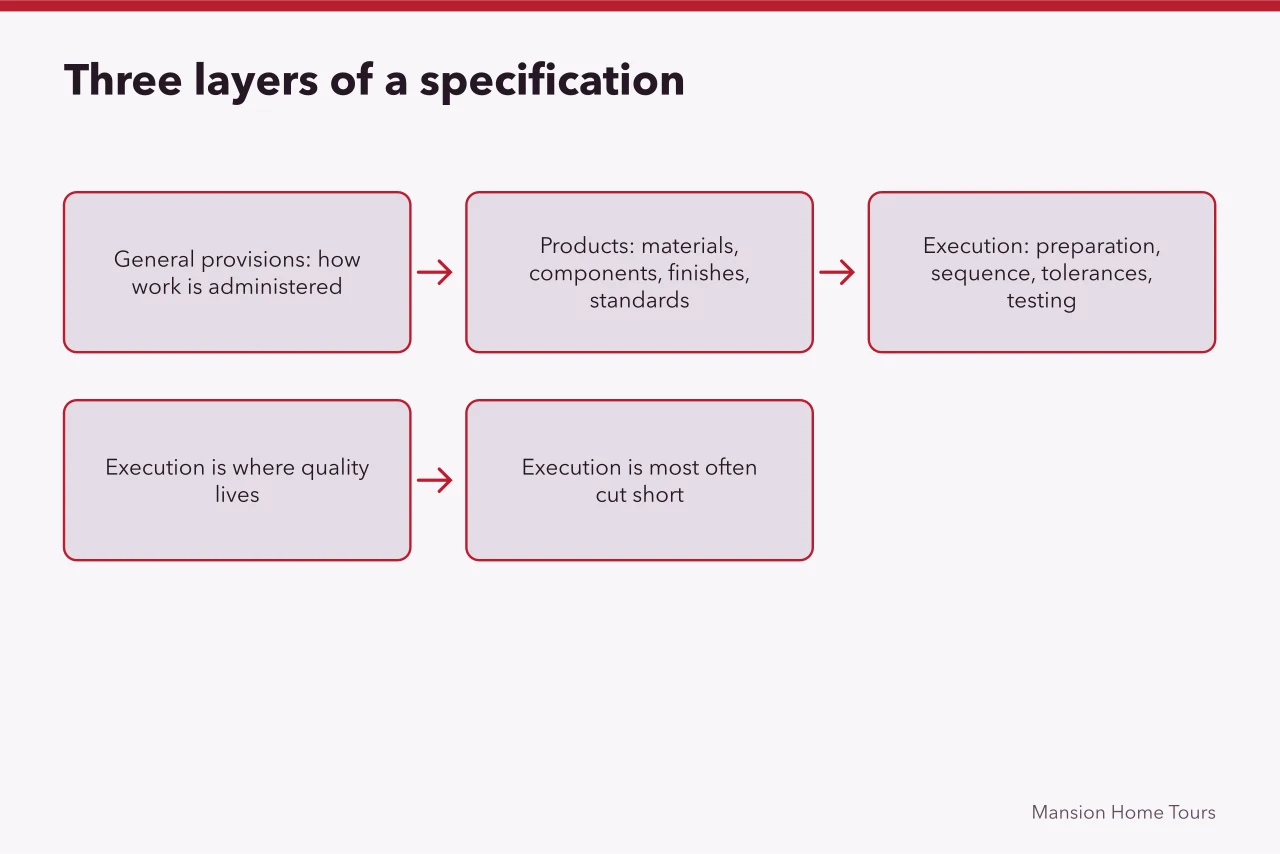
General provisions cover administration, submittals and inspection, and they set how a disagreement is resolved. Submittal review is billed work, often $100 to $250 per hour.
Products describe what things are, and the standard each must meet. Brand evidence is patchy, and sustainable material brands rated on evidence rather than hype are compared on criteria instead.
Execution describes how the work is done, from preparation through testing. This layer decides how long a floor lasts, and it gets cut first.
Product clauses: standards and listed prices
Named standards turn adjectives into tests. ASTM C840 covers gypsum board application and ASTM C754 covers steel stud installation. Tile methods sit in the TCNA Handbook, and AWI Premium Grade sets the top tier for architectural woodwork.
Carbon is documented the same way. Environmental product declarations explain the gap between an industry-average figure and a product-specific one.
Prices sit in the same document. As of 2026, a 1/2 inch USG Sheetrock panel lists around $15 to $20, and Rockwool Safe'n'Sound batts near $1 to $1.50 per square foot. Schluter-Systems Kerdi membrane runs about $1.50 to $2.50 per square foot, and Laticrete 254 Platinum thin-set about $40 to $60 per 50 pound bag.
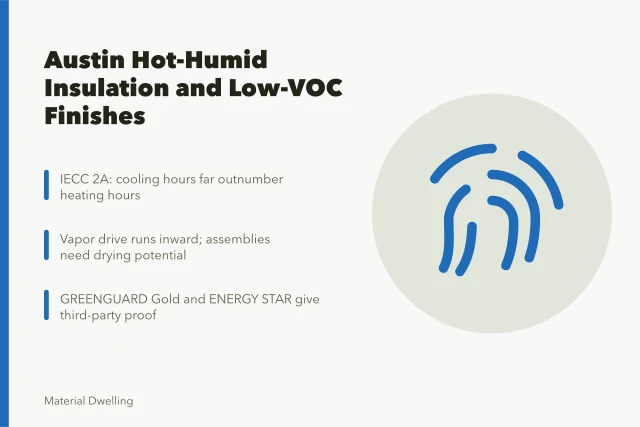
Mineral wool is one option among several. A regional guide to natural insulation in hot-humid and cold-dry US climates sets out where each type performs and where it fails.
Example: two identical bathrooms, nine thousand dollars apart
Same drawing, same tile. One bathroom gets Level 4 gypsum finishing and the other Level 5, which adds roughly $1 to $2 per square foot. Across 120 square feet, both look identical in a photograph.
Then the health side. If the joint compound and the sealant carry no named low-emission limit, the room can meet the drawing and still carry a heavy VOC load. EPA guidance on VOCs and indoor air quality lists the product classes that contribute most.
A product carrying the EPA Safer Choice label has been screened for chemical ingredients.
A bathroom specification worth reading names four things: the substrate tolerance, the waterproofing membrane, the adhesive and grout, and the finish coat. Each one needs a product standard and an emission limit. A realistic timeline for low VOC finishes projects shows how much curing time to add before a room can be occupied.
What drives the cost of the same room
| Variable | What changes, and the typical cost effect |
|---|---|
| Substrate preparation | Level 5 finishing adds $1 to $2 per square foot over Level 4, and a flat wall is a specified tolerance |
| Junction detailing | Trim, sealant and movement joints add $50 to $200 per linear foot |
| Number of trades | Every extra trade adds $500 to $3,000 per room in coordination and supervision |
| Sequence and access | Out-of-order work adds 5 to 15 percent to the affected package |
| Standard invoked | Moving from AWI Economy to Premium Grade can add 20 to 40 percent |
| Services in the fabric | Chases, boxing and access panels add $300 to $1,200 per opening |
Reading a specification you did not write
- Find the general provisions first.
- Read the execution clauses before the product clauses.
- List the standards that are named.
- Check the tolerances, because a specification with none hands the definition of acceptable to somebody else.
Labels are only as good as the rules behind them. Recycled content needs paperwork too, and how LEED and Green Globes reward recycled interior surfaces lists what a project team must submit.
Mock-ups turn an argument about words into a decision about a thing. A full-scale panel usually costs $1,000 to $5,000, and a third-party specifier charges $300 to $1,500 per section.