Features
Part of Testing low VOC finishes: what survived contact with a real wall
A realistic timeline for low VOC finishes projects: the useful version
Realistic timeline for low VOC finishes projects: how long a finishing project really takes once preparation, cure times and occupancy are counted.
What to take away
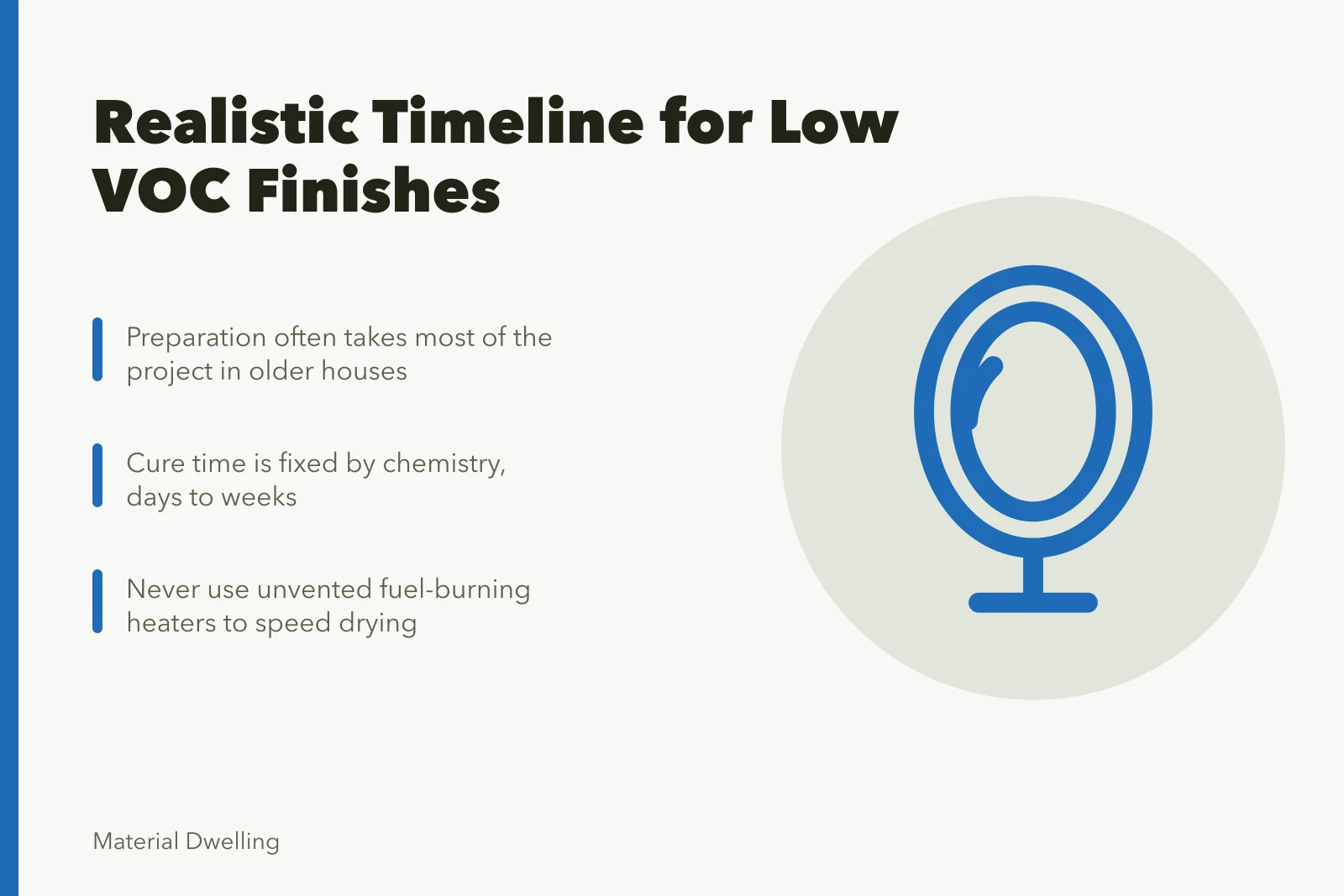
- Preparation takes longer than coating. In an older house it takes much longer.
- Cure time is fixed by chemistry, so it belongs on the calendar rather than in the optimism column.
- Plan occupancy around the dusty phases, especially where young children or pregnancy are involved.
- Never compress the schedule with an unvented heater. It is the wrong tool and a real hazard.
Where the time actually goes
Preparation. Filling, sanding, repairing plaster, cleaning and masking. In an older house with layered paint, this can be most of the project.
Where finishing time goes
- Preparationmost of project
- Primingfull day
- Coatingone day
- Curedays to weeks
- Reinstatementone day
Priming. Often a full day including drying, and unavoidable on repaired or stained surfaces.
Coating. The fast part. Two coats on a normal room is a day for a competent painter.
Cure. Days to weeks depending on the product, and it governs when furniture can return and when the surface can be cleaned.
Reinstatement. Rehanging, refitting, cleaning up, replacing filters. Consistently underestimated.
Occupancy is part of the schedule
In housing built before 1978, the preparation phase is the one that matters for health. Sanding and scraping create dust, and the people most affected are not the ones doing the work.
Who should be out during sanding
Was the home built before 1978?
young children and pregnancy vacate
asthma-sensitive person leaves during sanding
CDC sets out who is at increased risk from lead exposure, which for a household schedule means young children and pregnancy get planned around explicitly. That is a reason to sequence the dusty phases when the house can be vacated, and to use a certified firm that contains the work properly.
Even in newer housing, plan for someone with asthma to be elsewhere during sanding and for the first day after coating.
A sequence that holds
| Phase | Typical duration | Who should be out |
|---|---|---|
| Survey and testing | Days to a couple of weeks | Nobody |
| Repairs and sanding | One to several days | Everyone, in older housing |
| Cleanup after sanding | Half a day | Sensitive occupants |
| Priming | One day | Sensitive occupants |
| Coating | One to two days | Sensitive occupants |
| Ventilated cure | Days to weeks | Nobody, with ventilation running |
| Reinstatement | One day | Nobody |
Note the two rows that get skipped: cleanup after sanding, and the ventilated cure. Both are where the schedule quietly slips into the following weekend.
Build the schedule backward from the day the room must be usable, not forward from the day the paint arrives. Subtract the cure period first, since nobody can compress it. Then subtract coating, priming, and preparation in that order.
Whatever remains is your start date. If it is already in the past, move the deadline rather than shorten the cure.
Heat is not a shortcut
When a schedule tightens, the temptation is to warm the room to speed drying. Electric heating is fine. Fuel-burning portable heaters are not, because they produce carbon monoxide indoors.
EPA's guidance on protecting your family from carbon monoxide poisoning covers the household sources and the precautions, including alarms and never using fuel-burning equipment indoors in unvented conditions. A day saved on a paint schedule is not worth that risk, and the cure time does not shorten proportionally anyway.
The phasing discipline here mirrors the realistic timeline for insulation work, and the product decisions that set these durations are covered in our pillar on what held up in low VOC finish testing.