Reviews
Part of Natural insulation work inside a home: the stop-or-go survey checks
Insulation upgrades ranked by everyday comfort, not payback
Natural insulation and air sealing upgrades ranked by what you feel daily: drafts, cold floors, noise and smoke season, plus the material that suits each job.
What to take away
- Comfort is felt as surface temperature and draft, not as a number on a bill. This ranking of natural insulation and air sealing upgrades is ordered by that daily experience.
- Air sealing delivers the biggest daily change per dollar, and it is usually the cheapest line.
- A tighter envelope with proper filtration is what makes smoke season bearable indoors.
- Dense natural fiber insulation delivers real acoustic improvement that people notice immediately.
Value you feel, not value you calculate
Payback calculations dominate insulation marketing but say little about daily life. What people notice: the cold wall by the sofa warms, the floor draft vanishes, the ten-degree gap between upstairs and downstairs closes, and the house quiets.
Homeowners who skip air sealing often list the same regrets about natural insulation once the walls are closed up.
Rank upgrades by that experience. A sealed and insulated attic hatch is a trivial cost and removes a cold column of air over a landing. It will never appear on a savings estimate and it changes a hallway completely.
Where the daily return is highest
The cost column ranks each upgrade against the others in the table. It is a relative order for planning, not a price list.
| Upgrade | Everyday effect | Relative cost |
|---|---|---|
| Air sealing top plates and penetrations | Drafts stop, temperature evens out | Low |
| Attic hatch sealing and insulation | Cold spot removed from the landing | Very low |
| Rim joist sealing and insulation | Cold floors improve, especially in winter | Low |
| Attic insulation to full depth | Upstairs stops overheating and overcooling | Moderate |
| Dense pack in exterior walls | Comfort near walls, large noise reduction | High |
| Ventilation added with the work | Windows stop streaming, air feels fresher | Moderate |
The first three rows are cheap, fast and disproportionately effective. Most households would be better served spending on those and on ventilation than on chasing the last inch of attic depth.
Upgrades: everyday effect vs cost
Upgrade
- Air sealing top plates
- Drafts stop
- Attic hatch sealing
- Cold spot removed
- Rim joist sealing
- Cold floors improve
- Attic insulation full depth
- Stops overheating
- Dense pack exterior walls
- Comfort and quiet
- Ventilation added
- Windows stop streaming
Everyday effect
- Air sealing top plates
- Low
- Attic hatch sealing
- Very low
- Rim joist sealing
- Low
- Attic insulation full depth
- Moderate
- Dense pack exterior walls
- High
- Ventilation added
- Moderate
Relative cost
- Air sealing top plates
- Attic hatch sealing
- Rim joist sealing
- Attic insulation full depth
- Dense pack exterior walls
- Ventilation added
Diminishing returns matter here. Going from no attic insulation to full depth is transformative. Going from a good depth to a slightly better one is barely detectable in a room, though it looks meaningful on paper.
Spend the marginal dollar where the house is worst. In most American homes, that means air leakage and the rim joist, not an attic that already has some material in it.
Which natural material goes where
Each insulated row in the table has a natural material that fits the job. The upgrade comes first; the material follows from the space it has to fill.
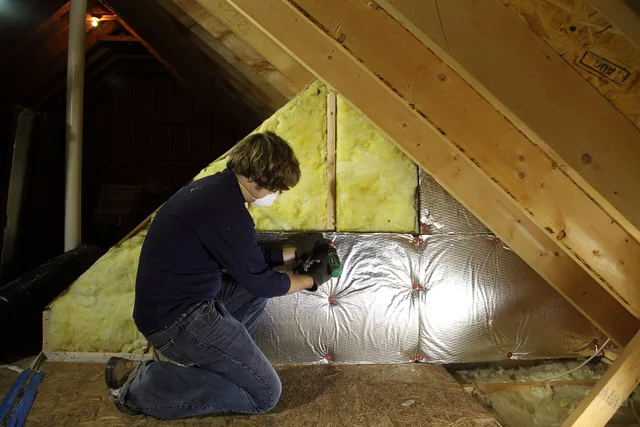
- Attic floor to full depth.Loose-fill cellulose, made from recycled paper, is blown over the existing layer and settles into the gaps around joists and wiring.
- Dense pack in exterior walls.Cellulose again, packed tightly into closed stud bays through small holes, which is what gives the noticeable drop in outside noise.
- Rim joist and attic hatch.Rigid wood fiber or cork board cut to fit, or sheep's wool and hemp batts friction-fitted into the bay, with the air sealing done first around the edges.
- Floors over a crawlspace or garage.Sheep's wool, hemp or cotton batts between the joists, held up from below.
Compare products within a material on the manufacturer's own data sheet for the exact product, since density and make change the result.
The smoke season case
Across much of the country, several weeks a year now involve keeping windows shut against wildfire smoke. A leaky house cannot do that: outdoor air comes in through the gaps regardless. Smoke season makes airtightness urgent, and a realistic timeline for natural insulation projects shows the testing and air sealing that must happen first.
A tighter envelope plus deliberate filtration is what makes the difference, and the two belong together. EPA's material on Indoor AirPlus and wildfires covers how tighter construction combined with filtration and ventilation strategy reduces smoke infiltration during these events. On the filtration side, EPA's wildfire smoke guidance recommends upgrading the HVAC filter to one rated MERV 13 or higher during smoky periods to remove fine particles from indoor air. For households in smoke-prone regions, that is a daily-life benefit that no payback calculation captures.
The air quality case, honestly stated
Insulation itself does not clean air. What it does is make the house controllable: when leakage is reduced, the deliberate ventilation and filtration you install can actually govern what comes in.
For households managing asthma, that control matters. CDC's guidance on controlling asthma and reducing triggers covers the trigger management side, including the indoor exposures that a drier, better-ventilated house makes easier to manage. The caveat is important: a tighter house without added ventilation makes indoor air worse, not better, which is why the two are always specified together.
Sequence the work using our guide to what happens at each stage, and screen the people who will do it with the contractor questions worth asking.