Reviews
Part of Which sustainable home renovation style is worth studying before you start?
Sustainable home projects products worth testing: a reviewer's notes
Radon kits, Tramex and Protimeter moisture meters, lead paint swabs and blower doors earn their cost; mold species sampling usually does not.
What to take away
Sustainable home projects products worth testing come down to a short list: radon kits, moisture meters, lead swabs, lab asbestos analysis and a blower door test. Each one ends in a decision.
- A test earns its cost only when a positive result changes your next move.
- Radon kits from Air Chek and AccuStar cost little and are the standard first screen.
- Tramex and Protimeter meters read substrate moisture before flooring goes down.
- LeadCheck swabs and lab asbestos analysis settle what a pre-1978 renovation can disturb.
- A Minneapolis Blower Door or Retrotec test sizes air sealing before the work starts.
- Mold species sampling rarely changes the cleanup, which is the same either way.
The test that decides the action
Ask one question before paying for anything: if this comes back positive, what do I do differently? A test that answers that is worth the invoice. One that does not is entertainment with a lab report attached.
Is This Test Worth Paying For?
If positive, what will I do differently?
defined action, worth the money
entertainment with a lab invoice
Radon kits, substrate moisture testing and hazard testing in older housing all pass. Each has a defined action attached to a defined result.
Radon: test, do not estimate
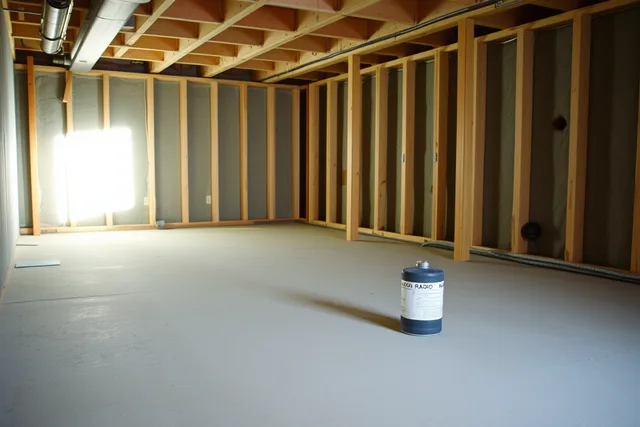
Radon is a colorless, odorless gas from the natural breakdown of uranium in soil and rock. It enters homes through the foundation. CDC's overview of radon and your health explains why testing is the only way to know a home's level.
Test before a basement is finished, a slab is covered, or an envelope is sealed. That gives a baseline and lets mitigation be built into the work instead of retrofitted. Radon varies by region, and regional differences in home projects decide how much mitigation a basement needs.
Two mail-order brands cover most of the consumer market. Air Chek's Short Term Radon Test Kit includes a charcoal canister, lab analysis and a prepaid return mailer, typically $15 to $25. AccuStar sells similar canisters and the AccuStar Continuous Radon Monitor, which logs hourly readings for a few hundred dollars.
First Alert's Radon Gas Test Kit sits on hardware store shelves for under $20 with the lab fee included. Airthings Corentium Home is a battery monitor that tracks short and long term averages, typically $150 to $200.
Kit prices are low enough that cost is not the deciding factor; the protocol is. Short-term kits need two to seven days of closed-house conditions, or the result is void.
Moisture meters: the flooring decision
A pin-type meter drives two pins into the material and reads electrical resistance. A pinless meter reads capacitance through the surface without marking it. Tramex builds pinless meters for concrete slabs and wood subfloors, including the Moisture Encounter ME5 and the CME5 concrete meter, typically $350 to $550.
Protimeter's Surveymaster combines pin and pinless modes in one unit, typically $400 to $550. The Protimeter Mini is a pin meter common on flooring crews, typically $150 to $250. Delmhorst and Extech sell budget pin meters for wood, typically $150 to $300.
The reading matters before any finish goes down. Wet concrete under a new floor traps moisture, and the failure shows up months later as cupping or adhesive release. Your flooring manufacturer publishes the acceptable moisture content for its product; that number, not a contractor's opinion, is the threshold.
Lead and asbestos: know before you disturb
Homes built before 1978 may contain lead paint. EPA-certified renovators test with swabs such as 3M LeadCheck, which turn pink on contact with lead. A kit of eight swabs typically costs $25 to $35 at hardware stores and paint suppliers.
Pro-Lab and D-Lead sell similar swabs for paint, ceramic and dust. A swab tells you the paint is there; it does not tell you how to remove it safely.
Asbestos is a lab question. Suspect material goes to an accredited lab under polarized light microscopy, and the report names the mineral. Floor tile, mastic, pipe wrap and textured ceilings are the usual finds.
EMSL Analytical and LA Testing are among the national labs that accept mailed samples. Single-sample PLM analysis typically runs $20 to $50, with turnaround measured in days.
Do not sand, grind or demo suspect material on your own. A licensed abatement contractor handles removal, and the requirements vary by state and municipality. Confirm with your state or local health department before work starts.
Blower doors and mold sampling
A blower door measures how leaky a house is. A technician mounts a calibrated fan in an exterior door, depressurizes the house, and reports air changes per hour at a set pressure.
The Minneapolis Blower Door from The Energy Conservatory and the Retrotec Series 1000 are the rigs most contractors use, and Retrotec's DM32 gauge logs the readings. A single test typically costs $250 to $500 in most markets.
That number sizes air sealing and ventilation before an envelope project, and it is the only way to know whether the work helped.
Mold species sampling is the test to skip. The response to visible growth is the same whatever grows there: find the moisture, fix it, remove or clean the affected material, and dry the assembly.
CDC's page of facts about Stachybotrys chartarum, the organism usually meant by "black mold", addresses the claims made about it directly. Reading it once removes most of the anxiety these services are sold against.
Air sampling has legitimate uses inside a professional investigation. As a homeowner purchase to decide whether to clean visible growth, it is not one.
What is worth paying for
Worth it when
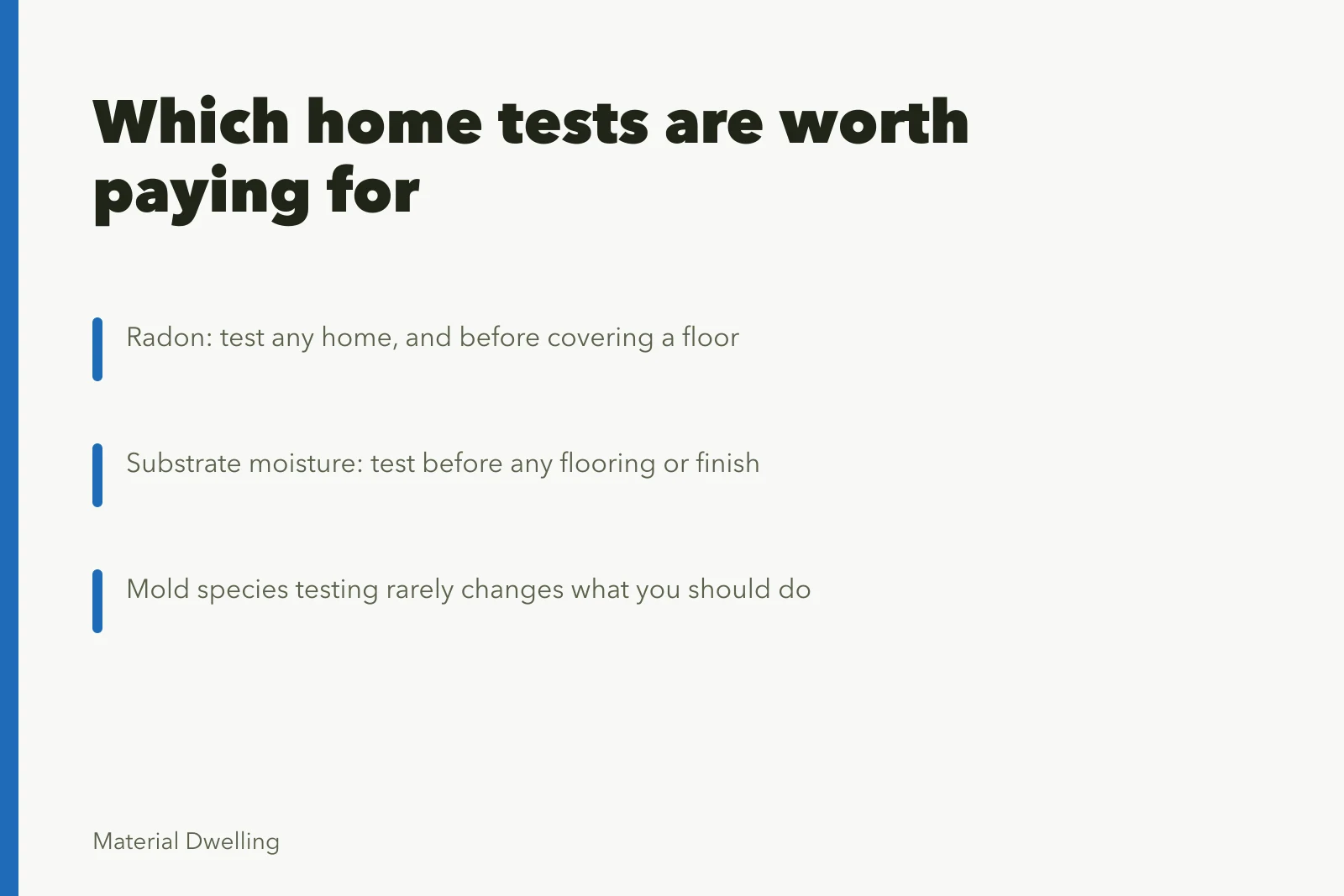
- Radon, Air Chek or AccuStar kit
- Any home, and before covering a floor
- Substrate moisture, Tramex or Protimeter
- Before any flooring or finish
- Lead in paint, 3M LeadCheck swab
- Pre-1978 housing, before disturbance
- Asbestos, accredited lab PLM
- Suspect materials, before disturbance
- Blower door, Minneapolis or Retrotec
- Before an envelope project
- Mold species, air sampling
- Rarely, in professional investigations
Action it triggers
- Radon, Air Chek or AccuStar kit
- Mitigation if the level warrants
- Substrate moisture, Tramex or Protimeter
- Barrier, product change, or delay
- Lead in paint, 3M LeadCheck swab
- Certified firm, containment, clearance
- Asbestos, accredited lab PLM
- Licensed abatement or leave in place
- Blower door, Minneapolis or Retrotec
- Sizing air sealing and ventilation
- Mold species, air sampling
- Usually none for a homeowner
Every worthwhile test ends in a decision that would otherwise be a guess.
Sequence testing with the project
Book tests early enough that results arrive before commitments are made. That is the same discipline described in the realistic timeline for insulation work. The product-level version of the same principle is covered in which product claims deserve checking.
Common questions
How long does a radon test take?
Short-term kits run two to seven days under closed-house conditions. Follow the kit or professional protocol exactly, because open windows invalidate the result. Air Chek and AccuStar both include the lab fee in the purchase price.
Is a cheap hardware store test reliable?
For an initial screen, often adequate. For a result you will spend money on, use a professional protocol. First Alert kits cost the least and use the same charcoal method as the mail-order brands.
Should I test air quality generally?
Consumer devices track humidity and particles usefully. They do not identify specific compounds and should not drive spending.
What if I see mold but it is small?
Clean hard surfaces, find and fix the moisture, and replace porous material that stayed wet. Testing first rarely changes that plan.